Showing posts with label Liturgy. Show all posts

Wednesday, November 16, 2011

St Gertrude the Great, ora pro nobis!


Prayer of St. Gertrude the Great

Hail, White Lily, of the ever-peaceful and glorious Trinity!

Hail, Vermilion Rose, the delight of Heaven, of whom the King of Heaven was born and by whose milk He was nourished! Do thou feed our souls with the effusions of thy Divine influences.

Friday, November 11, 2011

+ Nienstedt releases 28-page Pastoral Letter focused on Sacred Liturgy of the Mass

The Most Reverend Catholic Archbishop of Saint Paul and Minneapolis, John C. Nienstedt, has written a 28-page Pastoral Letter titled “Do This in Memory of Me”, that focuses on the “Sacred Liturgy” of the Mass, and the Catholic sacrament of Holy Communion. The pastoral letter will be distributed to all clergy and Catholic worshippers in the Archdiocese’s 12 county area.

Archbishop Nienstedt intentionally timed the publication of his initial pastoral letter to precede the implementation of the Vatican’s new form of the Roman Catholic Mass, scheduled to begin on the weekend of November 27, the start of the Advent season.

A pastoral letter, often simply called a pastoral, is a teaching document dealing with key beliefs and practices of the Catholic faith, explaining how these tenets of the faith, based on Christ’s teachings relate to societal problems or fundamental moral issues. The letter is a reflection based upon the bishop’s pastoral, teaching and Christian guidance responsibility.
details at Arch St. Paul & Minn.

St. Martin of Tours, ora pro nobis!

Entry of St. Martin into Amiens
As you know, Veterans Day is an annual United States holiday honoring military veterans. In other countries, the day is celebrated as Armistice Day. It recalls the ending of World War I at the 11th hour of the 11th day of the 11th month of 1918 with the German signing of the Armistice.

However, there is a deeper, Catholic meaning to November 11. This day is the feast of Saint Martin (c. 316 – 397) - that godly hermit and bishop who had once been a soldier. Martin laid down the sword in order to live a life of peace and penance under the gentle yoke of Jesus Christ. St Martin is Europe's chief example of the transition from soldier to saint; from war to peace.

Traditionally, November 11 had previously served as a day of signing peace treaties in honor of Saint Martin. Thus, it was fitting to end Europe's Great War on this same day - the festival of Saint Martin of Tours.

So there's a little Catholic history for you to share at the water-cooler or at your next cocktail party. Saint Martin is the ultimate veteran - a veteran from Christ.
Canterbury Tales

I was wondering how St. Martin and Veterans Day ended up on the same day.  That explains it!  By the way, Canterbury Tales is a great blog to follow.  

My grandpa on my mom's side was Marine and a Korean War vet.   Requiescat in pace. 

Thursday, November 10, 2011

La Crosse Sacred Worship director to appear on EWTN Theology Roundtable

Catch Father Martis and Professor Chris Carstens [Director of Sacred Worship for La Crosse Diocese] on EWTN! Theology Roundtable will air the first of a three part series on implementation of the New Missal, highlighting the Liturgical Institute's Mystical Body, Mystical Voice program.

Sunday 11/13, 10 PM Eastern
Tuesday 11/15, 1 PM ET
Thursday 11/17, 5 AM ET
The Liturgical Institute

This last Tuesday, Chris also presented at Theology on Tap in La Crosse.  He really did a fantastic job.  We had probably 20-25 people come.  As you can imagine, he's giving several talks a week and it really made me appreciate all the work he's been putting in leading up to Advent.  ...  I also realized that people my age do not think like me... or at least these ones didn't.  Someone was actually arguing(and laying it on pretty thick) that pro multis should not be translated  "for many" but that translating it that way was Calvinistic.  *sigh*  Chris was much more patient that I could have been.  Without getting into too many details, does this young man really think that the whole Church up until now actually was filled with a bunch of idiots who really couldn't figure out how to liturgically express this mystery?  It is so hard for me to communicate with modernists who basically disregard all of Church history in coming to a conclusion.  There are several reasons why pro multis is used.  Aquinas said in the Summa that "the many" was referring either to the elect among the Gentiles or to those for whom Mass is offered.  Yes Jesus died for all, even sinners who reject him, but the Mass isn't just an anti-Calvinism high five.  There is depth here that should be explored prior to a wagging of the finger. 

"He was offered but once to bear the sins of many. Why does he [St. Paul] say, 'of many,' and not 'of all?' Because not all had faith. Although He died for all, as far as He is concerned, to save all, His death voiding the downfall of mankind, yet He did not take away the sins of all, because they themselves did not want Him to do this." - St. John Chrysostom, exegesis for Hebrews 9:28

Alright I really didn't mean to rant beyond the fact that *gasp* people actually had thought of some of these things prior to the 1970s. 

HT SG

Tuesday, November 8, 2011

Blessed John Duns Scotus, ora pro nobis!

The Franciscan Monk Duns Scoto in his Cell
Perhaps the most influential point of Duns Scotus' theology was his defense of the Immaculate Conception of Mary. At the time, there was a great deal of argument about the subject. The general opinion was that it was appropriately deferential to the Mother of God, but it could not be seen how to resolve the problem that only with Christ's death would the stain of original sin be removed. The great philosophers and theologians of the West were divided on the subject (indeed, it appears that even Thomas Aquinas sided with those who denied the doctrine, though some Thomists dispute this). The feast day had existed in the East since the seventh century and had been introduced in several dioceses in the West as well, even though the philosophical basis was lacking. Citing Anselm of Canterbury's principle, "potuit, decuit, ergo fecit" (God could do it, it was appropriate, therefore he did it), Duns Scotus devised the following argument: Mary was in need of redemption like all other human beings, but through the merits of Jesus' crucifixion, given in advance, she was conceived without the stain of original sin. God could have brought it about (1) that she was never in original sin, (2) she was in sin only for an instant, (3) she was in sin for a period of time, being purged at the last instant. Whichever of these options was most excellent should probably be attributed to Mary.  This apparently careful statement provoked a storm of opposition at Paris, and suggested the line 'fired France for Mary without spot' in the famous poem "Duns Scotus's Oxford," by Gerard Manley Hopkins.

This argument appears in Pope Pius IX's declaration of the dogma of the Immaculate Conception. Pope John XXIII recommended the reading of Duns Scotus' theology to modern theology students.
Wiki

... I wonder how many modern theology students have been exposed to Duns Scotus.  You may have heard the Friars of the Immaculate have put together a movie on the life of Bl. John Duns Scotus.  It is in Italian but Ignatius Press is now selling the DVD with subtitles. 


Monday, November 7, 2011

Cardinal Burke in Amsterdam, to visit St. Louis in January


New Liturgical Movement

Via STL Catholic:
His Eminence, Raymond Cardinal Burke, Archbishop Emeritus of Saint Louis, will visit St. Francis de Sales Oratory this coming January 31st. He will pray the Te Deum and lead Eucharistic Adoration and Benediction. Mark your calendars now, and I will update as I have more information.

Thursday, November 3, 2011

In GB, "Catholics prepare for most significant reforms since Vatican II"

The revisions reflect a new translation for the English-speaking world of the Roman Missal, the official Latin-language set of worship documents. It includes words and instructions for conducting the Mass, the central act of Catholic worship, in which priests bless and distribute bread and wine as essentially the body and blood of Jesus.

Virtually every prayer and proclamation in the Mass is undergoing at least some revision, marking the biggest change in worship for American Catholics since they began having Masses in English rather than Latin after the reformist Second Vatican Council of the 1960s.

Locally, the Catholic Diocese of Green Bay has been planning for the changes for more than a year, according to Sister Ann Rehrauer, director of evangelization, living justice and worship for the Green Bay diocese. In addition to training for priests, the diocese has held informational workshops about the changes and parishes have formed study groups to prepare. Rehrauer also has been writing columns about the Roman Missal for The Compass, the diocesan newspaper.

"This will be quite a change for people," Rehrauer said. "The people in the pews will not notice it as much. There will be some things they will pray differently; some word changes. … But for the priest, every single prayer they pray has been retranslated with a different style of translation."
GB PG

Friday, October 28, 2011

"We discovered about 30 hymnals containing the Body of Christ" in MN parish

Having attended Mass at St. Elizabeth Ann Seton these past two weeks, you may have heard Fr. Cole or me address a situation that we have been made aware of over the past several weeks. Heartbroken and with tears in their eyes, we have been approached by parishioners with open hymnals. What has caused the tears has been their discovery of the Body of Christ, partially consumed, stuck between the pages of a hymnal. After another incident this past weekend, I invited our NET Team (National Evangelization Team assigned to SEAS) to open and search all of the hymnals. We discovered about 30 hymnals containing the Body of Christ.

At Mass we receive the Body, Blood, Soul and Divinity of Christ. Jesus Christ gives His life—not to be placed within a book—but within our soul. In light of this desecration of the Holy Eucharist, our parish has suffered with Christ. Let’s remember Who we are receiving within the Consecrated Host.

I am sharing with you this sad information to remind us that not everyone respects the gift that Jesus Christ and His Church is giving to us. While we may be brought to tears literally— as have parishioners who have brought me these hymnals—please remember that when we miss Mass, we also risk misleading our children. Our absence at Mass may lead our children to think that Jesus is also absent in our worship.

To address this situation going forward, please teach by example. Honor the Holy Will of God and the Divine Gift of the Holy Eucharist and make the commitment now to never be absent from the celebration of Sunday Mass again. Regarding each of our liturgical ministries, special instructions are being given to our Extraordinary Ministers of the Holy Eucharist, Ushers and Sacristans to address this heart-wrenching concern.

If you have any questions regarding this message, please feel free to speak to Fr. Cole, Megan Pleviak, our new Director of Worship, or myself.
St. Elizabeth Ann Seton, Hastings MN

Photo

Madison Diocese Office of Worship issues correction on Communion

Don’t stop ordering sacramental wine or sell your common chalices! Bishop Morlino has not “outlawed” Communion under both kinds and he has stated that he never will. Currently there is no diocesan plan or timetable regarding the Communion Rite.

The reports from the Phoenix Diocese concerning the expiration of an indult regarding Communion under both kinds seem to have been mistaken. I have contacted the USCCB Secretariat for Divine Worship regarding this. While there was permission granted to the US Bishops for Communion under both kinds on Sundays and Holy Days of Obligation (October 13, 1984), there was no time limit noted in the decree on file in the USCCB. My assumption is that this somehow was confused with another indult (regarding the purification of sacred vessels by EMHC) that expired and was not renewed around that same time. Unfortunately the internet has perpetuated this to the point that it is considered to be true, even though there is evidence to the contrary.

The current law (GIRM no. 283) is clear. The pertinent part says:

The Diocesan Bishop may establish norms for Communion under both kinds for his own diocese, which are also to be observed in churches of religious and at celebrations with small groups. The Diocesan Bishop is also given the faculty to permit Communion under both kinds whenever it may seem appropriate to the Priest to whom a community has been entrusted as its own shepherd, provided that the faithful have been well instructed and that there is no danger of profanation of the Sacrament or of the rite’s becoming difficult because of the large number of participants or for some other cause.

We tend to focus on the faculty “to permit whenever appropriate” and pass over “provided that the faithful have been well instructed and that there is no danger of profanation of the Sacrament…” The U. S. Norms (no. 24), which are the particular law for our nation, further state that the excessive use of EMHC, if it obscures the role of priest/deacon as ordinary minister of Holy Communion, may be a reason to limit Communion under both kinds.

The General Instruction of the Roman Missal is available online at http://usccb.org/prayer-and-worship/roman-missal/general-instruction-of-the-roman-missal/ . The Norms for the United States are online at http://nccbuscc.org/liturgy/current/norms.shtml . Both also are published in the front matter of the Roman Missal, third edition.

I am hoping to outline some questions for reflection for pastors and liturgical leaders to reflect and evaluate on some of the “conditions” mentioned above (as well as some other items). This won’t be done immediately, but will be a priority. In the meantime, you are free to move on this as you wish. If you are not prepared to give a serious catechesis on this, my suggestion would be to hold off a bit until this first becomes clearer in your mind (through study and prayer). I am certain that the Bishop wishes to move in this direction. I am equally certain that he is desirous that it is done well so that it deepens, rather than harms, the faith of your people and the unity of the Church. 
the entire letter at Madison Diocese 

more details at Fr. Z's

Thursday, October 20, 2011

Iowa monks and their llamas settle into new home, and iritate Iowa dioceses

The sympathetic nature of their rare Argentine llamas reflects the ministry of Benedictine monks making a home for themselves in the former Buchanan County Care Facility.

Argentine llamas have a spiritual quality that is consistent with the monks’ mission of healing, mercy and charity, said the Rev. Ryan St. Anne, abbot of Buchanan Abbey, which opened earlier this year in the three-story brick building that had long served county residents who could not care for themselves.

“I can’t tell you why, but if you put your arms around one, you’ll understand,” the abbot said.

Buchanan Abbey, which has operated under other names in other Midwest states, has had a contentious relationship with the Catholic Church, in part because it adheres to a traditionalist view that rejects reforms instituted by the Second Vatican Council in 1963.[I'd really like to know the details here.  VII was mostly(in ambiguous mushy fashion) just a reaffirmation of what the Church already taught.  Maybe they reject some of the reforms after the council?]

Neither the Vatican nor several Midwest dioceses, including the Archdiocese of Dubuque, recognize it as a Catholic institution. In fact, in a Sept. 4 statement, the Archdiocese of Dubuque warned its faithful “to exercise great caution in relating to” Buchanan Abbey.
Monsignor Thomas Toale, vicar general of the archdiocese, said the warning was prompted by public notices that Mass and other religious services are being performed at the abbey and that its abbot is a Roman Catholic priest.

[now get this....]“No evidence has been provided to the officials of the archdiocese of a valid ordination to the priesthood … and the institution is clearly not in communion with the archbishop of Dubuque, who has not given any permission or approval to the institution,” the statement said.

St. Anne said he was originally ordained in 1993 and later reordained by Bishop James Byrne of the Dubuque archdiocese and that he has the documents to prove it.

Buchanan County Supervisor Ellen Gaffney, a Catholic, said she initially had reservations about selling the former county home to the abbey.

“But we didn’t have any other offers, and I thought it best for the people of the county to get some money out of it — it sold for $125,000 — rather than having to pay to tear it down,” she said.

The supervisors’ subsequent good relationship with the abbey and its monks has alleviated those initial concerns, she said.

“They appear to be an asset to the community, and we wish them well,” Gaffney said.
 continue at Cedar Rapids Gazette

Very interesting article, and I think reported well, worth reading the whole thing, including the fact they are growing and attracting Franciscans and Carmelites to join their order.  Not sure if they are operating under emergency faculties or what or if they won't step in line regarding liturgy.  Is the Traditional Mass offered anywhere in the area?  Will tradition minded Catholics be pushed to this order because dioceses in the area have not supported or taken action on Summorum Pontificum?

Monday, October 17, 2011

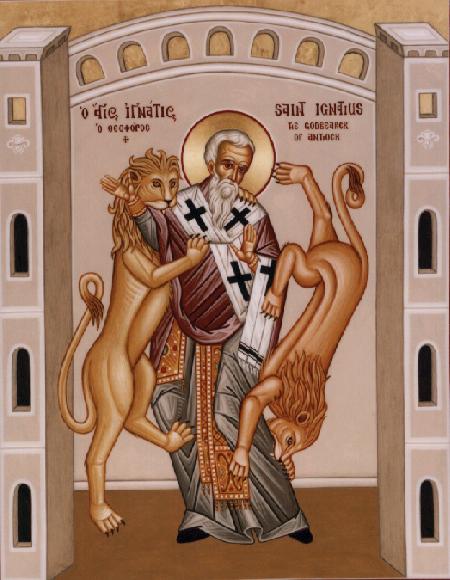
St. Ignatius of Antioch, ora pro nobis!


"I prefer death in Christ Jesus to power over the limits of the earth.  He who died in our place is the object of my quest."
- St. Ignatius of Antioch

more at Abbey Roads

Friday, October 14, 2011

Diocese of La Crosse "not discussing" normalizing Communion under both forms

Source
The Diocese of La Crosse will not adopt a controversial new policy in Madison to phase out wine during regular communion services.

Catholic Bishop Robert Morlino has asked priests in the Diocese of Madison to move toward using only bread in regular Masses, reserving the use of both bread and wine for more solemn or special occasions.

The change would be a significant departure from current U.S. Catholic custom[this is precisely why when the USCCB requested the extension of the temporary 1975 indult allowing this practice, it was denied by Rome] , although bread-only is the norm in many other parts of the world. Madison would become only the second diocese in the country known to limit wine as a general policy.

Asked to comment about the change, La Crosse Diocese spokesman Stan Gould issued a one-sentence statement: “This is not a topic that’s been discussed by the priests of the diocese and is not under consideration.”
La Crosse Trib

I'm kind of surprised nobody want to blame the old white man in Rome for not being more pastoral...  What is so funny about the Church is that something this significant goes unnoticed for 6 years and everyone complains when the same law that permits Mass in the vernacular is followed.  If there was a new provision to allow clowns during Mass, these same folks would be clamoring that the law be followed. 

Interestingly phrased response...  Is he saying that the bishop IS considering it then?  Or did the response come directly from the Vicar for Clergy? 

Since we are talking Diocese of La Crosse today, how's everyone liking their new priests?  I've heard a lot of struggles within formerly solid parishes throughout the dioceses(some growing pains I guess should be expected).  Even theories as to why it was done....  .... ah, but I digress.  You can comment anonymously if you want but be charitable or you won't get approved.

Did I mention I went to Holy Trinity in La Crosse a couple months back and the priest changed the words of the Nicene Creed from "born of the Virgin Mary, and became man" to "born of the Virgin Mary, and became human."  We had thought about joining that parish at one point.  GUESS NOT.

Thursday, October 13, 2011

All I need is a miracle

Source
Source
Source
Source
Source
Source

Except from The Miracle of the Sun at Fatima by Fr. John A. Hardon, S.J.
Why Are Miracles Important?

Miracles are not only important; they are indispensable for the credibility of our faith. They are God’s way of enabling us to believe that someone, who claims to be speaking for God, is really telling the truth.

The logic is very simple. Someone says that he is a spokesman for God. The prophet or seer is proclaiming something which requires divine authorization to be accepted on faith. But people can make all kinds of claims to being mystics or communicators of an alleged divine mission to the human race. How are their claims to be accepted? They are accepted on the grounds of sound reason not on blind credulity. Their claims are acceptable only if the claimant gives evidence of being in contact with God. Who then uses this human spokesman as the agent of a prodigy that could only be performed by the power of God?

That is why in the Gospels Christ was constantly associating two things: his teaching and his miracles. Sometimes he would work the miracle before revealing a truth that He wanted to have believed. This is what He did when He fed the five thousand people with five loaves and two fishes, which was clearly a miracle. Then, as described by St. John, He made the astounding pronouncement of giving his own flesh to eat and his own blood to drink in the Holy Eucharist. This was the revealed mystery that Christ wanted his followers to believe.

At other times Jesus would first reveal the mystery and then perform the miracle. That is what He did when He first told the man, dropped through the roof, that his sins were forgiven. That was such an unheard of claim, that the Pharisees protested “Who but God can forgive sins?” So, we may say, Jesus countered their skepticism by telling the paralyzed man to pick up his mat and walk. The miraculous healing of the paralytic provided the rational basis for accepting Christ's claim that He, the Son of Man, had power on earth to forgive sins because He was also the Son of God.

How Does the Solar Phenomenon Confirm the Message of Fatima?

It was no coincidence that the solar phenomenon at Fatima came only several months after the basic message of Fatima had been communicated to the children. The phenomenon had to have a purpose for its occurrence, and the message had to have a divine confirmation of its authenticity.

When the phenomenon occurred in October, it was witnessed by thousands of people, friendly and unfriendly, simple believers and professed skeptics, those disposed to believe Our Lady’s message and others who were openly hostile to what the Blessed Virgin was reported to have said.

In God’s providence the hostility of the skeptics was necessary to give rational grounds for believing what the children said the beautiful Lady was telling them. All the reports of those who witnessed the spectacle of the sun testify to their stupefaction at what they saw. No one, not even the most hardened agnostic, doubted that what he saw was a prodigy. This was necessary to provide the rational foundation for accepting, on faith, the Marian message of Fatima because of the solar event which everybody had to accept, as a fact, perceived by the senses.

Why, then, was the solar prodigy of Fatima necessary? It was necessary in order to satisfy our spontaneous need for giving rational credence to what Mary was telling Lucia, Francisco, and Jacinta. The children did not need the solar phenomenon to believe what Our Lady was telling them. But we do.

It is not coincidental that Mary asked her Divine Son to work the miracle at Cana as the first of the signs performed by her Son. Immediately, we are told, his disciples believed in Him. She has been doing the same ever since. As God, He is master of the sun, moon and stars which He created. Her message at Fatima was to tell a sinful world to stop offending the Divine Majesty and to repent of their sins. As at Cana, she asked Jesus to work a miracle. At Cana, as the poet said, the water looked at its Maker and blushed. At Fatima the sun looked at its Maker and whirled in dazzling splendor to acknowledge its Creator.

Wednesday, October 12, 2011

Bp. Morlino offers clarification letter to Madison Diocese priests

Dear Brother Priests,

As I stated at the Presbyteral Assembly, and as I clarified in a letter to all of you, my chief intention in considering specific points in the liturgy, is simply to encourage throughout the diocese, a greater sense of reverence and a real truthfulness in what we say and do at the Mass. I still plan to send you some bullet points with regard to specific matters we discussed, but one individual point seems already to have drawn attention, and so I feel I must send and make public this letter to assist all of us in our teaching office.

There can be no doubt that the need for catechesis exists. There is also little doubt that some of these matters can be difficult to catechize. Without my issuing any public instruction other than a letter confirming my personal request to you to teach your people according to the General Instruction of the Roman Missal, the “blogosphere,”[It wasn't me! It wasn't me!  When I read that, I started to sweat wondering what slipped out of my fingers and onto the blogosphere.  It turns out nothing!  Yea!]  has begun speculation and, perhaps, innuendo that I have decreed communion under both species should be completely done away with. You and I both know, no such decree has been, or will be made. As you know, and as I hope you are telling those who wonder, all I’ve done is to ask you patiently, prudently, and practically, to begin instructing your people according to the Roman Missal and implementing the General Instruction.

Since there seems to be some confusion with regard to what the GIRM says, I’ll remind you that you can order the document on-line from the USCCB Office of Liturgy (making certain that it’s the third edition). Here, however I’ll mention a few germane points from the document and, specifically, from the “Norms for the Distribution and Reception of Holy Communion under Both Kinds in the Dioceses of the United States of America (Norms),” which the USCCB document includes.

We’ll first go back as far as the Document of the Second Vatican Council, Sacrosanctum Concilium, which states:

“The dogmatic principles which were laid down by the Council of Trent remaining intact, Communion under both kinds may be granted when the bishops think fit, not only to clerics and religious, but also to the laity, in cases to be determined by the Apostolic See, as, for instance, to the newly ordained in the Mass of their sacred ordination, to the newly professed in the Mass of their religious profession, and to the newly baptized in the Mass which follows their baptism (SC, 55).”

Without here going into the “dogmatic principles laid down by the Council of Trent,” it is worth noting the examples that Vatican II considers when allowing communion under both kinds – newly ordained priests at their ordination, religious sisters and brothers at their profession, and those coming into the Church at their baptism and first communion. With these examples given by the Council for the distribution of Communion under both species, it would be hard to argue that Vatican II envisioned communion under both forms every week.

Now, with the issuance of the Roman Missal, the Church gets more specific in matters such as these (thus the General Instruction which we are presently using as our guide). The Missal goes further than the Vatican II document, instructing that the Chrism Mass and Corpus Christi would be good occasions for distributing Communion under both species, as might be the distribution to wedding couples at their marriage, to children receiving their First Communion, to Confirmation candidates at their Confirmation, to consecrated religious at their conventual Mass, to women and men on retreat, and to deacons and seminarians at any Mass. The document also allows the pastor to choose certain other days, such as the patronal feast of the parish, to distribute under both forms, so long as the reasons are good and so long as all other conditions are met. But it does warn pastors:

“In practice, the need to avoid obscuring the role of the Priest and the Deacon as the ordinary ministers of Holy Communion by an excessive use of extraordinary ministers might in some circumstances constitute a reason either for limiting the distribution of Holy Communion under both species…(Norms, 24)”

The Third Edition of the Roman Missal reinforces the right of bishops to make additional allowances for reception of Communion under both species, beyond that which the documents already mention:

“The Diocesan Bishop is also given the faculty to permit Communion under both kinds whenever it may seem appropriate to the Priest to whom a community has been entrusted as its own shepherd, provided that the faithful have been well instructed and that there is no danger of profanation of the Sacrament or of the rite’s becoming difficult because of the large number of participants or for some other cause (Roman Missal, 283).”

This permission has been assumed, if not expressed directly in the past. I recognize this, and I understand fully that communion under both forms at every Mass has become common practice at some parishes.

However, I have been told of, and have personally experienced, the reality that the provision both that the faithful be well instructed and that there be no danger of profanation of the Sacrament, is not being met. As such, while recognizing the need for patient, prudent and practical steps according to your individual parishes, I’ve asked you to move in this direction.

As I’ve said, over and over again, and as you know well, this requires catechesis. So many do not understand the Eucharist as the memorial of Christ’s Sacrifice, his death and resurrection; nor the real presence of Christ, body, blood, soul, and divinity, under both species of bread and wine; nor the role of the ordinary and, if necessary, extraordinary ministers of the Eucharist. Most of all (and this has been my point from the start) so many of our people do not understand the kinds of reverence due at all times to the sacrament, whether within the Eucharistic Liturgy or outside the celebration.

This gets back to the need for the new translation, and every point I’ve attempted to make. What we say and do at the Mass, and what we do before the Lord present in the tabernacle matters.

Thus, I cannot in good conscience, allow us to go forward without addressing these matters. That’s specifically what I’ve asked you to do. Please help your people to know and understand the beautiful gift we have in the Eucharist, to know our obligations of preparing for reception of the Sacrament, both in terms of our preparation through the Sacrament of Confession, our observance of the pre-communion fast, our attending to our attire as best we can, and the like. Please help them to know of Christ’s presence, fully and entirely in the Sacred Host. Our people know well, the aspect of the Mass which is the Sacred banquet, but help them to know the Eucharist at the Memorial of Christ’s loving Sacrifice for them. Help them to understand your role in laying down your own life as the minister of Christ’s Body and Blood, present in the Host.

Christ offers Himself, whole and entire, Body, Blood, Soul and Divinity at every Mass to every woman and man who is prepared to receive Him. At the end of the day, our goal should be to help every, man, woman and child really to understand this, in a profound and life-changing way. If we recognized the gift that we already have, what an impact that would make upon us and upon the world! So, let us tell out this Good News!

Faithfully yours in Christ,
Most Rev. Robert C. Morlino
Bishop of Madison
Madison Diocese

I saw Fr. Z has some good commentary over at his place.

I would follow this man to the ends of the earth.

HT Ben Yanke

Tuesday, October 11, 2011

WisSJ: Bishop Morlino to priests: Hold the "communion wine"

Credit: Diane Korzeniewski, OCDS
Madison Catholic Bishop Robert Morlino has asked priests in the diocese to move toward using only bread during regular communion services, reserving the use of both bread and wine for more solemn or special occasions. [I think host and cup or chalice would be a better way to address the species]

The change would be a significant departure from current U.S. Catholic custom, although bread-only is the norm in many other parts of the world. Madison would become only the second diocese in the country known to limit wine as a general policy.

However, diocesan officials stressed Monday that Morlino has not issued a directive to priests.

“He has not issued a formal mandate or set a fixed timeline but has asked pastors to exercise their own leadership to move in this direction,” said Monsignor James Bartylla, the diocese’s second-in-command.

Morlino first discussed the topic with priests at a retreat late last month, Bartylla said.

In a letter to priests Monday, Morlino said the change was needed to deepen laypeople’s reverence for the Eucharist, the Catholic term for communion. Catholics believe bread and wine, when consecrated by a priest, become the actual body and blood of Christ. [Well, some of us do anyway.]

Morlino wrote that he has personally experienced occasions when reverence for the consecrated wine “is not being met.” 


The use of consecrated wine at regular Masses often requires non-ordained parishioners to assist priests in helping with distribution. Some believe this increases the likelihood of unintentional mishandling of Christ’s blood through careless treatment, spillage or swilling[swilling??].

“Wine, as a liquid, is much more subject to accidents and misuse than bread,” Bartylla said. “There are practical and logistical difficulties.”

Catholic teaching holds that only one form — consecrated bread or wine — is needed to receive Christ’s full person, while both together constitute “a fuller sign” of the Last Supper.  [I think that was JPII's take on the issue... although I never understood what that actually meant.]

Travis Ganser, a member of the Cathedral Parish, said he supports the move.

“If you really believe what the church teaches and that the bishop is the church’s shepherd, then decisions like this are easy to accept,” he said.

Jim Andrews, a member of St. Thomas the Apostle Church in Beloit, called it “sort of a ridiculous idea.” [and added "fer sure, like totally"..]

“This changes the meaning and traditions that I know,”[those two word do go together, don't they?] he said. “The other practical ramification is there will be fewer laypeople involved in services.” [what a concept!]

That rationale for dropping wine was hotly debated Monday by Catholic scholars.

Anthony Ruff, a Benedictine monk and associate professor of theology at St. John’s University in Collegeville[gee, I wonder what his take on the matter will be], Minn., said the failure to get an explicit extension just means the universal rules of the church kick in.

“Nothing in the universal rules of the church requires the bishop to restrict both forms,” he said. “This decision is absolutely unnecessary. The bishop has full authority to allow communion under both forms at all Masses if he wishes.”

Ruff called the move “demoralizing to dedicated priests and lay ministers in the diocese.”  [oh, what?  Ah, yes, thanks for waking me up after his comments were over.]

But Dennis Martin, a theology professor at Loyola University in Chicago[Interesting!], said any U.S. diocese routinely distributing both forms “is in violation of church rules.”

“A renewal was requested and not given,” Martin said. “I’m sorry, that sounds to me like a pretty deliberate and intentional statement of bread-only.”

He praised Morlino’s move as “quite reasonable and quite practical.”

Officials with the Madison diocese said examples of when both wine and bread might be used include marriage ceremonies, ordinations and occasions that are solemn in nature for the diocese or individual parishes.
The whole thing at WisSJ: http://host.madison.com/wsj/news/local/article_12b3e3d0-a352-58c0-aeca-148b7b8bf0bf.html#ixzz1aV1GZV5i

They go into the history, early church loved having that chalice passed around, etc.  Really not a terrible article though, balanced out, I mean they are trying to report on these things well which is nice to see.  Ha, and if you want to take a look at the picture that goes along with the article it made me laugh. 

Monday, October 10, 2011

FatherZ: Diocese of Madison, WI, to stop regular Holy Communion under both kinds. The indult ran out in 2005.

These are Fr. Z's comments. He has more details over at his place.
Dear Friends in Christ:
Maybe you noticed a story in last week's Catholic Herald about new norms for Communion under both species in the Diocese of Phoenix. You may have wondered why this story from Arizona received such prominent coverage here (on page 3 of the Catholic Herald, where letters from Bishop Morlino appear). In fact, the story was featured because it will be significant for us as well. Bishop Morlino spoke to us priests about this while we together at Wisconsin Dells at the end of last month.

In the last couple of decades, Communion under both species (with the congregation able to receive the Pre-cious Blood as well as the Sacred Host) has become routine in our experience. I knew (as many of you do) that Communion under both species was first introduced, on a limited basis, after the Second Vatican Council, and that it has become much more common since. What I did not know was that the widespread American practice of offering both species at most Sunday Masses began here under an indult (special permission) given by the Vatican in 1975, which expired in 2005.

 [Get that everyone?  The key points: it was a special permission to depart from the norm and that permission expired.]

Almost no one realized that until very recently. Maybe we can be forgiven for forgetting that we were operating under a temporary indult. After thirty years, something can seem pretty permanent. But it wasn’t. The bishops of our country did apply for an extension of the 1975 in-dult, but that was denied.

So, all over the United States, we now find ourselves needing to bring our practice into conformity with current regulations (and with the rest of the world). In his comments at Chula Vista, Bishop Morlino mentioned a few instances in which Communion under both kinds is still permitted: the Chrism Mass, the Feast of Corpus Christi, for the bride and groom at a Nuptial Mass, and for those so allergic to wheat that they cannot tolerate even low-gluten hosts. Beyond those occasions and circumstances, Communion can be offered under both species at celebrations of special importance. But it is clear that we will not be seeing Communion under both species as a weekly practice.

Bishop Morlino understands that this comes as news to all of us. He is giving pastors considerable latitude as to the timetable for implementing this change. He suggested that the beginning of Advent (when the new translation of the Missal is fully implemented) would be one plausible date to make the change. That will be our timetable here at the Cathedral Parish (and also at St. Paul’s University Catholic Center, the other parish clustered with us).

Msgr. Kevin D. Holmes
Madison Cathedral

You may have heard me say this before. From time to time Catholic folks will ask me about moving to Wisconsin, and will try and get a feel for the state. If you have a choice of location, the best place to be is as close to Bishop Morlino as possible. I would be at his Cathedral parish in Madison if I was put in that situation.